
India's Recent Political Regime and the Criminalisation of Dissent
The curious case of West Bengal

India still performs democracy with confidence. It votes, it counts, it transfers power, and it congratulates itself for the procedure. That is not nothing. But the more interesting question in 2026 is what the state does between elections, and what it does to people who insist on speaking before a court has decided whether they have done anything wrong. In that interval, law has become less a neutral frame than a pressure machine. West Bengal, after the BJP’s first victory in the state on 4 May 2026, has moved briskly in that direction too, with a new law-and-order style of governance that treats disorder, criticism, and dissent as species of the same problem.
Sedition by another name
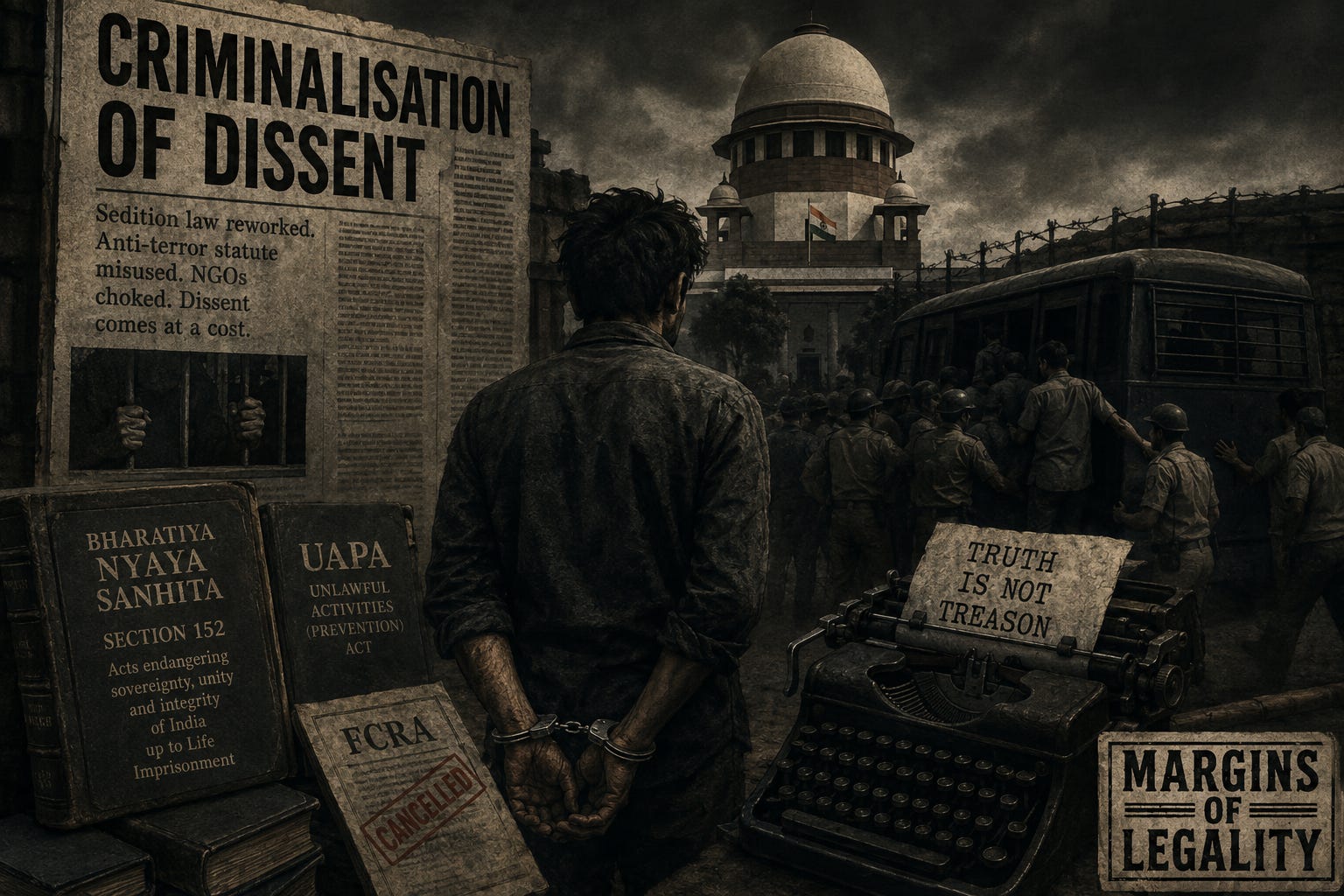
Section 124A of the old Indian Penal Code spent more than a century doing what colonial sedition laws always do: making speech governable by police. The Supreme Court put sedition trials in abeyance in 2022, but the state did not abandon the project. It renamed the offence as Section 152 of the Bharatiya Nyaya Sanhita, in force since July 2024, and kept the core structure intact: speech, writing, signs, electronic communication, and even financial means can be folded into a charge that concerns sovereignty and unity. In August 2025 the Supreme Court issued notice on a challenge to the provision, and granted interim protection from arrest to Siddharth Varadarajan in a case arising from an article on Operation Sindoor. The point is not subtle. The law was revised, not relinquished.
The use pattern matters more than the wording. In 2025 Assam police moved against The Wire and two of its editors under Section 152, prompting the Court to step in and restrain coercive action. That episode was not about rebellion in any serious political sense. It was about making publication itself hazardous, and then making the journalist prove, at considerable cost, that the state’s theory was absurd. A Marxist reading does not need to romanticise dissent to see the point. When the state cannot easily silence criticism, it raises the price of criticism until only the stubborn, the well-resourced, or the reckless can continue. That is not democratic neutrality. It is class power wearing a legal collar.
Years spent waiting: the UAPA as punishment by process
The Unlawful Activities (Prevention) Act remains the state’s bluntest anti-terror tool, and its most revealing feature is not how often it secures conviction, but how often it secures custody first. Parliamentary data tabled in December 2025 showed 10,440 arrests under the UAPA between 2019 and 2023, with only 335 convictions over the same period. Jammu and Kashmir accounted for 3,662 arrests and 23 convictions. In May 2026, the Supreme Court itself noted that conviction rates in UAPA cases nationally were only in the low single digits, and below 1 per cent in Jammu and Kashmir. The Court’s point was not academic. A statute with that arrest-to-conviction ratio is doing work long before trial, and often long after the public has stopped paying attention.
This is the deeper logic of the law. The state does not need to win every case. It only needs to make the process punitive enough. Umar Khalid has now spent more than five years in custody without his trial concluding. Irfan Mehraj was detained in 2023 on UAPA-linked charges and, by March 2026, had spent three years inside before receiving bail in July. These are not isolated tragedies. They are the visible edge of a system in which pre-trial incarceration, delay, and uncertainty become the real sentence, while the formal verdict comes later, sometimes years later, when the damage is already complete. In Marxist terms, this is not a malfunction of the state. It is one of its ordinary instruments.
Closing the space for civil society
The Foreign Contribution (Regulation) Act has also been tightened into something less like regulation than discipline. Amnesty International reported on 17 July 2026 that the Ministry of Home Affairs adopted new amendment rules on 22 June 2026 giving the government sweeping powers over the activities, management, leadership, and internal functioning of foreign-funded NGOs. The new framework narrows the list of acceptable activities, adds fresh layers of disclosure and approval, and effectively excludes a range of work on rights, civic participation, and accountability from foreign support. Amnesty also notes that the rules apply to nearly 14,500 organisations already holding FCRA licences. The language of national interest remains broad enough to invite selective use. That is the real point. In the hands of a state hostile to independent scrutiny, financial regulation becomes political filtration.
The government’s defence is familiar: transparency, anti-money laundering, anti-terror financing, public order. Some of that is not inherently illegitimate. States do have an interest in tracing money. But the scale and design of the rules matter. Amnesty points out that the latest amendments follow years of increasingly restrictive changes, including the 2020 ban on sub-granting and the administrative spending cap, and that the effect is to constrain rather than merely monitor civil society. A state that can deny funding, narrow permitted activity, and require intrusive reporting does not need to ban dissent outright. It can starve it. That is how liberal legality can be made to do illiberal work without ever announcing the contradiction.
West Bengal after 4 May 2026
West Bengal deserves separate attention because its new BJP government has moved with unusual speed. The BJP won the state for the first time in the 4 May 2026 election, ending 15 years of Trinamool Congress rule. By late June, the new assembly had passed the West Bengal Public Safety and Control of Anti-Social Activities Bill, 2026, along with an amendment to public order law. The bill allows preventive detention of suspected “anti-social” persons for up to 12 months without trial, and the government said it was aimed at riots, violence, and recovery of property damage. The state’s own defenders present it as a law-and-order statute. Critics hear something else: a discretionary apparatus that can be turned from crime control toward protest control with very little friction.
The implementation came quickly. On 19 May 2026, the state issued a circular prohibiting government employees from direct or indirect communication with the press without prior sanction, and from criticising government policy in publications or public utterances. The language is bureaucratic, which is often how repression prefers to dress. Then, on 13 July, the anti-gang and property-auction laws came into effect. Within days the government invoked the new law for the first time in connection with violence around a NEET protest in Kolkata, filing multiple FIRs and making arrests while warning that the consequences would be remembered for generations. On 27 July, after a Supreme Court order, the state said it would not take coercive action against peaceful protesters, except those with criminal records. That sequence tells its own story: first the warning, then the law, then the test case, and only then the judicial check.
The state government says it is drawing a line between protest and violence. That line is not imaginary, and no serious critic should pretend otherwise. Some rallies do turn destructive. Some organisers do exploit political anger. Some police action is plainly justified. But the breadth of the new law, combined with a media gag on officials and a willingness to invoke “goons” as a political category, creates a climate in which the boundary between disorder and dissent can be redrawn by executive convenience. That is why the law matters even before it is abused. It shifts the burden of caution onto everyone else. Students, journalists, lower-level officials, and civil society groups start editing themselves in advance. The state has no need to forbid speech if it can persuade people to fear the paperwork attached to it.
How the world scores it
India’s external ratings remain poor for reasons that are now hard to dismiss as merely methodological prejudice. Reporters Without Borders places India at 157 out of 180 in its 2026 World Press Freedom Index, down from 151 the previous year, and says press freedom is in crisis amid violence against journalists and concentrated media ownership. Reuters reported in July 2026 on a youth protest in India where a reporter was assaulted amid fury over media bias and a crackdown on student demonstrators. That is not the same as state censorship, but it does reveal a deeper institutional sickness: when the press is seen, often accurately, as aligned with power, public trust collapses and violence moves into the space left by legitimacy.
The strongest objection to this argument is simple enough. India still has competitive elections, the judiciary still intervenes, and the state still loses sometimes. West Bengal itself is proof of democratic turnover, however unsettling the political outcome may be for those who preferred the previous regime. The Supreme Court has already restrained coercive action in the Section 152 cases, and it has in recent months acknowledged the weakness of UAPA conviction rates. Some FCRA cancellations are rooted in real compliance failures, and some protest prosecutions are no doubt tied to actual violence. A fair analysis must admit all of that. The problem is not that every use of law is cynical. The problem is that the legal architecture now makes cynicism unnecessary. It is built to function coercively even when officials claim to be acting neutrally.
That is the broader pattern. India is not a place where dissent has vanished. It is a place where dissent has become expensive. Section 152 makes publication risky. UAPA makes pre-trial custody normal. FCRA narrows the oxygen supply of civil society. West Bengal’s new laws extend the same logic at the state level: preventive detention, property recovery, media silence, and fast moral language about “goons” and “anarchy.” A Marxist would not be surprised. When a ruling order feels itself under pressure, it rarely abolishes legality. It repurposes it. The state remains democratic in form, but coercive in rhythm. The verdict still comes later. The punishment begins much earlier.